
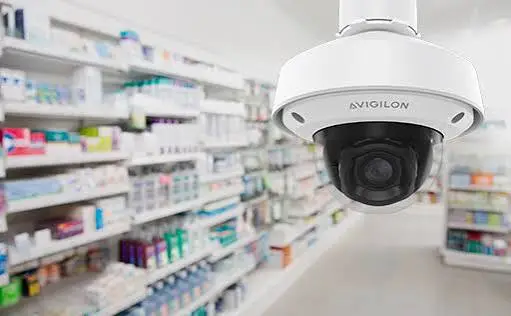
Few retail businesses in the GTA have faced the security pressure pharmacies have in recent years. Narcotics are valuable on the street, pharmacies are open to the public, and many sit in plazas with large glass storefronts. For pharmacy owners, security is about protecting staff and patients as much as inventory.
The good news is that one major threat has dropped sharply. The other one, overnight break-ins, still depends largely on how well the building itself is secured.
Quick Answer: How Do Pharmacies Prevent Robberies and Break-Ins?
Pharmacies reduce daytime robberies with time-delayed narcotics safes, signage, cameras and panic alarms. Overnight break-ins are a separate risk that targets the building when no one is there, usually through the front glass or entry doors. Protecting against both means pairing in-store controls with impact-resistant glazing on the storefront and doors.
Two Different Threats
Daytime robberies
A robbery happens while the pharmacy is open. A suspect approaches the counter, often with a weapon, and demands narcotics. The risk here is mainly to staff and customers.
Overnight break-ins
A break-in happens after close. Suspects force their way into the empty store, usually through the glass, and try to reach the dispensary. The risk here is mainly to inventory, property and the business’s ability to open the next day.
The measures that work against one do not automatically work against the other.
What Worked Against Robberies
Toronto saw pharmacy robberies climb sharply in 2022. At the height of the problem, the Toronto Police Service Hold Up Squad advised owners to invest in cameras, panic alarms and time-delayed safes, and to keep those safes closed at all times.
The safes made the biggest difference. After time-delayed narcotics safes were fully implemented in community pharmacies across Ontario, Toronto police reported an 82 per cent drop in pharmacy robberies compared with the same period a year earlier. The Ontario College of Pharmacists explained why: people who rob pharmacies depend on getting in and out quickly, and a safe that cannot be opened on demand removes that option.
That lesson applies to break-ins too. Speed is the whole strategy.
The Threat That Remains: Overnight Break-Ins
Overnight break-ins are not new. In one joint investigation, Halton and Peel police linked a crew to 23 nighttime pharmacy break-ins across the GTA and southwestern Ontario, with about $500,000 in narcotics taken.
A time-delayed safe protects the narcotics inside it. It does not stop someone from breaking the storefront, damaging the dispensary, stealing other high-value stock, or trying to remove the safe itself. Every overnight break-in also brings glass replacement, cleanup, inventory reconciliation, regulatory reporting and lost trading time.
Why the Storefront Matters
- Most pharmacies have large glass frontages, especially in plazas and on main streets.
- Standard and tempered glass break quickly, and once tempered glass fails it leaves a full opening.
- Alarms alert, but do not delay. A crew that expects to be gone in minutes plans around response times.
Applying the same principle that made time-delayed safes work, the goal is to make getting in slow enough that the attempt fails.
A Layered Security Plan for Pharmacies
- Keep time-delayed safes closed and post signage. Both are now standard practice in Ontario and both deter robberies.
- Use cameras and panic alarms. Cover the counter, dispensary, entrances and exterior approach.
- Secure the dispensary area. Limit access to staff and keep it locked outside operating hours.
- Light the exterior. Storefront and rear door lighting improves camera footage and visibility to passing traffic.
- Harden the storefront glass and entry doors. This is the physical layer that stops an overnight break-in at the front of the building.
Strikeglass for Pharmacies
Strikeglass commercial security glazing is built to resist repeated impacts from hammers, crowbars and similar tools. It is bonded onto the existing storefront and door glass, so the pharmacy keeps its bright, open frontage and no full storefront replacement is needed. Most installations are completed within a day and can be scheduled outside pharmacy hours.
The same approach suits medical, dental and veterinary clinics that keep medication on site.
Frequently Asked Questions
Are pharmacy robberies still a problem in Toronto?
Toronto police reported an 82 per cent drop in pharmacy robberies after time-delayed safes were implemented across Ontario community pharmacies. Overnight break-ins remain a separate risk.
What is a time-delayed safe?
It is a safe that only opens after a set waiting period. Because robbers depend on speed, the delay removes much of the reason to target a pharmacy for narcotics.
Do time-delayed safes prevent break-ins?
They protect the narcotics inside the safe but do not stop someone from breaking into the store, damaging property or stealing other stock.
What is the best way to protect a pharmacy storefront?
Combine exterior lighting, monitored alarms and cameras with impact-resistant glazing on the storefront and entry doors, so a break-in attempt fails at the glass.
Can Strikeglass be installed without closing the pharmacy?
Yes. It is bonded onto the existing glass, and installations are typically completed in a day, often scheduled after hours.